The big band Theory is a popular TV show on CBS
that everyone loves. But something that most people don’t know is that its an
expert in rhetoric and shows you different balances of rhetoric and different
types of people, better yet they all get along. There are 4 main characters.
Sheldon, Penny, Leonard, and Howard. Leonard has an IQ of 173, Sheldon is a
genius, and Howard is just a geek. Penny on the other hand is the typical girl,
living across the hall that has a dream of being a movie star. She gets along
with these 3 guys as if they have known each other their entire life. This shows
that even though the 3 guys have different patters, and behavioral methods
toward interacting with people they all seem to interact together well.
Although Sheldon is a genius, he has a social disorder and is the opposite of
penny, quiet, shy and a little over barring, but who wouldn’t be with his
knowledge. As the series goes on they seem to teach each other different things
and give each other different experiences. The most used rhetoric device that
is used in the show is sarcasm. The show has a witty way about it, being a
balance between educational, humorous, and just dramatic. They play jokes on
each other and are just living their normal life just as someone else would who
lived in the city. The sarcasm is vital in this show because it gives it the
context that it wants; it is throughout the dialogue of the show until the end.
Another device would be irony. This is a huge one considering they are all the
smartest of the smart, geek guys who befriend a beautiful and poppy girl. Its
ironic because looking at these guys you wouldn’t even think they have what it
takes to even talk to girls. Most of the jokes and humor is educational, so
sometimes it helps to look it up on Google, but it is a great show that teaches
friendship, love, and that smarts is a must. It ties in humor into something educational, which in all honesty makes it even funnier. Its very entertaining and if you’ve
never seen it its worth the watch.
Tuesday, March 31, 2015

Monday, March 30, 2015
The Rhetoric of Game of Thrones
In
HBO’s hit television series Game of
Thrones, which is based on George R.R. Martin’s “A Song of Ice and Fire,”
rhetoric plays a key, if hidden, role in the story. Some characters, like Lord
Eddard Stark of Winterfell, are characterized by a lack of rhetoric. Lord Stark,
a man who values honor, would doubtlessly agree with Plato’s view of rhetoric
as dishonest. Others, like King Robert Baratheon, just have little patience for
the persuasive power of rhetoric and prefer coercive power. Indeed many of the
characters are men and women of action not word.
But for other
characters, like the dwarf Tyrion Lannister, rhetoric is everything. Naturally,
the dwarf cannot rely on his actions but he makes up for his small size with
his words. Tyrion, most of all, understands Kairos, or “the supreme moment,” as
evidenced by his perfectly timed witticisms. At one point, a captive Tyrion
urges his captors to let him confess his crimes, they allow him the perfect opportunity
to talk his way to freedom. Soon afterward, Tyrion is again in a precarious
situation, confronted with a dangerous tribe he convinces them to save his life
and even to fight for him in an upcoming battle. Meanwhile Lord Varys, Master of Whisperers,
also exemplifies the role of rhetoric in the fictional lands of Westeros and
Essos. What Lord Varys knows best is how to play to his audience. In a conversation
with Lord Stark he even says, “Oh, I feed [Lord Baelish] choice whispers,
sufficient so that he thinks I am his … just as I allow Cersei to believe I am
hers.” To which Lord Stark replies, “And just as you that you were mine.”
Recently
a Sci Pop Talk at UNL titled “A Song of Ice and Fire and Chemistry” was given
by Dr. Raychelle Burks. She explained that we can use our understanding of the
real world science to figure out the fictional world of Westeros. Perhaps, we may also use our understanding of
real world rhetoric to understand this fictional world. Then we may just learn
something about ourselves and the real world we all live in.
Sunday, March 29, 2015
"Wait For It..."
Catchphrases are quite common in many television shows, including “Bazinga!” by Sheldon Cooper in The Big Bang Theory, “Live long and prosper” by Spock in Star Trek, and of course “You’re fired!” by Donald Trump in The Apprentice. Some of these catchphrases had become viral, while some of them even become memes. “Wait For It...” is one such example of a catchphrase that turned into a meme which is also viral.
“Wait For It...” has been used as a phrase since the late 1990s by popular films including Harold and Kumar Goes to White Castle and Notting Hill. However, this catchphrase is more prominently used in the 21st century by Barney Stinson, portrayed by Neil Patrick Harris, in How I Met Your Mother. “Wait For It…” is used in conversations to build up suspense in anticipation for a climactic or an exciting event. In the Internet, this catchphrase is used to inform the audience about a gradual, sometimes uninteresting buildup that leads to an out of the blue revelation of an event or act.
Perhaps, the most famous example of “Wait For It…” used by Barney is the part where he says “Legen… wait for it… dary!” However, there are also many instances where Barney used “Wait For It…”. In fact, Vulture has compile a list of times where Barney used that catchphrase in How I Met Your Mother, which is about 40 times! The other main characters, Marshall and Lily had a baby and even named the baby Marvin Waitforit Eriksen.
One of the things that made “Wait For It…” viral was the usage of the catchphrase in the title of a Youtube video, “Thriller cat… wait for it”. The video utilized the famous Michael Jackson song, Thriller, and had a cat which was lying down at first walking defensively. Besides, many people began to put up memes of Barney’s “Wait For It…” in multiple instances, including funny comments, birthday wishes, and even being awesome.
I believe that “Wait For It…” is viral because it is quite funny, and the idea can be easily replicated into the same form (“Legen… wait for it.. dary!” being passed through in the same form). The catchphrase is also a meme because it is understood culturally by people who watch How I Met Your Mother frequently. The catchphrase can also be used in other contexts by just utilizing “Wait For It…”, making it not only exclusive to “Legendary” but in other ways as well. Invention of new memes of the catchphrase is evident, which gives it a new meaning every time. However, because How I Met Your Mother has reached its series finale, the popularity of this meme has decreased.
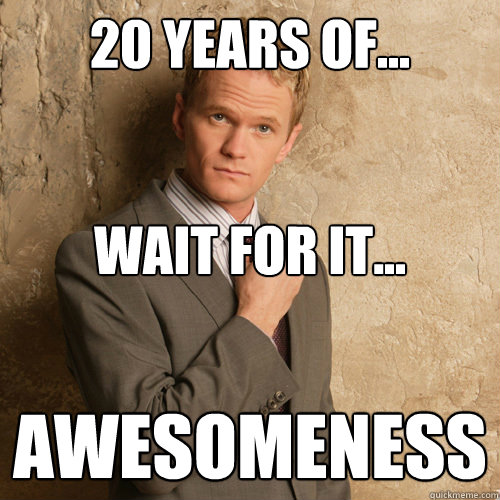


Pictures are taken from Google Images.
Can constraints lead to creativity?
After discussing in class the 140 characters on Twitter and if it can promote creativity, I started debating in my head whether it could or not... It is a struggle trying to figure out if character count constraints or rhyme scheme constraints can actually lead to conveying a message in a more creative way.
Because we have 140 characters on twitter, are we really thinking of a more creative way to tweet something, or are we just figuring out what spelling errors or grammatical errors are "okay" to publish. Instead of creating a more clever way of saying something, we could easily be just shrinking our original thought. Then I started thinking about examples in my life; I have wanted to tweet something long once and then thought about how to say the same thing but less characters and it worked. Was I being creative by just shortening my thought? By definition, yes I was being more creative. I created a whole knew way of conveying my thought BUT, did the constraint lead to a MORE creative tweet?... I believe so.
Because I built on one tweet and the new one was shorter and more concise, I believe it was more creative. I ended up using more effective words and that is most likely the case for others that have been in the same situation.
Also in class I brought up the idea of hip hop and the constraints they face. A typical verse is 16 "bars" and normally have a specific rhyme scheme. Now, in some cases songs are not very creative and rhyme schemes are fairly easy. But sometimes, a rapper will put a constraint on his or herself and I believe that can make for a more creative song. For example, there is a rapper from Maine named Spose. In one of his songs he gave himself a constraint; the constraint was rapping using only the letter "r" for every word and the song is called "All R's." With this constraint he gave himself, he was able to formulate a story with just words that started with r. If he had not given himself this constraint, I don't think he would have just written a verse in the same manner.
This poses the question: can constraints lead to creativity?
I believe they can and they do.
Tuesday, March 24, 2015
New media and its role on social activisim
New Media and its Role on Social Activism
New media such as the Internet and social media have had a
huge impact on our society. It has made our lives easier, for now everything
it’s at the palm of our hands. All we got to do is open our computers and we
can find information, news stories, buy things online among other million
things one can do on the internet. A few of the advantages of new media such as
social media are that it reaches millions of people, it’s broad in audience and
allows the transfer of information in a rapid way. These advantages facilitate
the new role that new media has taken in the social activism world. With the
raise of Twitter and Facebook more and more activists emerge. However, it’s
important to note that these platforms did not create new activists. Social media only organize activists. Social
activism has been around for a long time with out the help of updating status,
sharing photos or videos, or the need for 140 characters.
The Internet it’s a great tool for activism, but we must
know to not solely rely on it. New media allows people to get together for a
common cause. For example, the ALS bucket challenge. There were 4.4 million
Tweets with the #icebucketchallenge hashtag. Another example it’s the Kony 2012
campaign, the video about Joseph Kony reached 100 million views, and there were
5 million tweets about the video. Even though social media is a great tool for
social activism, it lacks one very important factor-human activity. These
platforms promote an effort to promote these causes, but it makes human
activity no more possible, and this is important to fight any social cause. The
notion that these people were involved, interested, and interacted with the
cause on social media supports Malcolm Gladwell’s argument about the limits of
social media and the ability to make a revolution and make change. Gladwell
argues that social media platforms create weak ties between people. These ties
are just not strong enough to motivate people to take risks, to take action
beyond just interacting with the cause on social media. Taking risks is what
sparks a revolution on our society. The Civil Right movement and the Arab
Spring are some examples of causes that succeeded, for they were fought based
on strong ties and. Those movements relied on strong bonds the ones that only interaction
between friends, family or colleagues can make.
There is a really good quote by Gladwell that summarizes the
role that social media plays today on social activism “[Social media] activism succeeds not by
motivating people to make a real sacrifice but by motivating them to do the
things that people do when they are not motivated enough to make a real
sacrifice,”. We all can agree that this is very true, and
in fact many of us have been guilty of it. There has been a time that we
believe that by just sharing an article, or posting about a cause that is
enough to make a change. Well, it is not. Pretending to care about a social
cause is not actually caring at all because if we would truly care our actions would
go beyond just clicktivism. I would challenge you and my self to really think
about this, and next time you want to do something for a cause would do more
truly activism and less slacktivisim.
Works cited:
http://www.dailydot.com/lifestyle/malcolm-gladwell-social-media-revolutions-twitter/
http://www.theguardian.com/news/datablog/2012/apr/20/kony-2012-facts-numbers
http://www.splashscore.com/8-social-media-stats-behind-the-ice-bucket-challenge/
Friday, March 13, 2015
Man is the Measure & Absolute Truth
Protagoras believed that there were no absolute truths, everything was relative to each person. He believed that "Man is the measure of all things; of the things that are, the things they are, the things that are not, that they are not." Each specific person has their own viewpoint and their life experiences have shaped and molded them to see things the way that they do. One example that has often been given for this, is temperature. One person may believe that it is cold, while another person believes that the same temperature is hot. Everything is all about relativity. This can be seen in our culture today. It rings true about politics, war, laws and nearly everything else. One specific example of this can be seen in Islamic State of Iraq and Syria. This particular group is made up of a particular type of extremist Muslims that are trying to an Islamic state that follows strict Sharia law. Sharia law impacts nearly every aspect of life, both religious and non-religious. Sharia law requires that boys and girls must be separated at school, music is banned, women are forced to wear a full veil in public, as well as a variety of other strict rules and harsh punishments.
When it comes to religion, there is no absolute truth. Man is the measure of religion, each man (or women) measure what is and what is not. Each man has the power to decide if and which religion they decide to practice. Religion is all about beliefs which is why each man has the right to choose. Extremist groups form when a person feels that the way that life is being lived is not how their God intended it. These groups will resort to violence when they feel that they are not being given the opportunity that they feel they need. In the case of ISIS, these men and women feel that the communities in which they live are not sufficient for them to practice their beliefs in. They have resorted to violence, terror and war in order to attempt to create a place where they feel that they belong.
No man can say with absolute truth that the actions of ISIS are wrong, because there is no absolute truth when it comes to right or wrong, or good or bad. What one person believes is the best, may be what another considers the worst. We all have a "moral compass" or a code of ethics that is instilled in us as we grow older but that compass is different for everyone. This is what can cause violence and terror and create groups like ISIS.
ISIS has recently released a video that shows what appears to be a young boy shooting a man who they claim is a "spy". Each man has to measure their opinion on this act. Although I personally believe that the actions of ISIS are wrong, there is no actual right or wrong.
Man is the measure of all things. Each man (or woman) decides for themselves what is right or wrong, or good or bad. There is no one correct answer or one explanation. Although the actions of another group may not seem "right" to one, does not mean that the person/group is a bad group. Each group does what they believe is right. This world allows for us to have choice and make decisions, with no absolute truth, there can be no wrong decision.
http://www.washingtonpost.com/world/middle_east/islamic-state-claims-slaying-of-arab-israeli-spy-in-latest-video/2015/03/11/a02a96bc-c7ed-11e4-aa1a-86135599fb0f_story.html?wprss=rss_middle-east
Saturday, February 28, 2015
The Argumentum ad populum fallacy, or How to Not Be Cool at Parties.
Among
the most regularly appealed to and obnoxious fallacies used in popular culture
today when evaluating or discussing practically anything at all is the “argumentum
ad populum” fallacy, better known as the Appeal to Popularity Fallacy. For the
sake of this essay, let’s define this particular logical fallacy as follows: any
argument that concludes that a proposition is true because many, most or
perhaps even all people believe it to be true.
Perhaps
in today’s countercultural zeitgeist (the term “hipster” alone has metamorphosed
from churlish, teasing pejorative to a loving term of endearment, happily
employed by anyone who’s even momentarily glanced at The Smith’s VEVO page)
affecting especially the college demographic (i.e., everyone part of this
blog!), maybe the notion that “things are good because lots of people like them”
seems a bit less legitimate. But trust me: it’s a pervasive and toxic mindset
that continues to weasel its way into every day discourse.
Take,
for example, the $200 million dollar blockbuster Guardians of the Galaxy, an
utterly tiring space opera/comic book mash-up that none the less smashed box-office
records to pieces and topped many critics “best junk food movies of the year.”
Pretty much every single conversation that begins, “Gosh, I can’t really say
Guardians of the Galaxy struck me as a particularly good film…” will almost
instantly be struck down with the argumentum ad populum fallacy.
But thankfully,
now that you’ve read this you’ll be better prepared to sling back, “That, good
madame/sir, is a popularity fallacy! The notion that something has inherent
worth based purely on the fact others—however many—like it is a wholly
fallacious one!” I mean, sure, you’re probably not going to score any cool
points or top any ‘deepest thinkers of the year’ list just for complaining
about whatever popcorn flick is invading Hollywood War of the Worlds-style at the moment, but
at least you’ll have your guns and you’ll be sticking to them. And if Hollywood
is to impel you to believe anything at all, isn’t it that it’s always good to
have your guns handy? I mean, just look at Guardians of the Galaxy...
Subscribe to:
Posts (Atom)