Saturday, September 27, 2014

Kids and Networking


While reading about the importance of social networking in the Rainie and Wellman reading, I came across this line “…a few important family members, close friends, neighbors, leaders and community groups (churches and the like) constituted the safety net and support system for individuals”. I was reminded of a speaker that came to my high school to talk about the importance of strong connections for kids. Just like it was important for Trudy and Peter to have a wide range of connections to get them through a tough time, the same is especially true for kids as they grow up. This is essentially what Phlight Club (the organization that came to speak) was trying to get across, but in a really unique way that also opened my eyes to why people respond and recover to stress and hardship differently.
               I want to start off explaining the activity Phlight Club had us do with inflated balloons. There were all sorts of different colored balloons, of all different sizes and shapes. The point was to not let any of the balloons touch the floor, which proved to be difficult for the smaller ones, since they weren’t very buoyant and would fall to the ground faster and more often. The activity was analogous to the way some kids get into more trouble, and need more support to recover when they are faced with hardship. I often wondered why it was so difficult for some of my peers to cope with homework, stress, and confidence in general, and I would often get impatient with them. Phlight Club explained that these differences are because we all have a different “web of support”. Your “web of support” is made up of adults that have “high expectations and provide opportunities, teach skills, and celebrate relative best”. They can be your parents, neighbors, coaches, teachers, or any adult you are close with. However, some kids don’t have as many of these supportive adults as others do. Generally, the more adults in a kids “web of trust”, the more successful, independent, and confident they are. These kids are the balloons that you’d only have to hit once, and they’d float up in the air for a long time. On the other hand, kids that don’t have many adults in their web aren’t as easy to “keep afloat”. From a teacher’s standpoint, they require a lot more prompting, supervision, and checking in than the others do. As a rule of thumb, Phlight Club suggests each kid has at least 5 trusted adults in their web.
So what exactly is the ‘web’ made up of? Each trusted adult contributes ‘strings’ in the web. They can be support, opportunities they offer, encouragement, values, etc. They can also be talents, characteristics, and other abilities these adults help kids realize they possess, and in bringing them to light, builds their confidence.  The more adults there are to contribute, the less gaps there are in the web, which means less opportunities for the ‘balloons’ to fall through. There are several other factors that contribute to the web, which Phlight Club represents by using colors of the rainbow (ROYGBIV) to help remember. They are:
Red The Rule of Five (Anchors for the “Web of Support”): The foundation for each youth’s own personal village is having five caring adults (or more) in their lives, who have high expectations and provide opportunities, teach skills, and celebrate relative best in appropriate ways.
Orange Tangible Supports (Adding strings to the “Web of Support”): Measurable supports provided through the youth’s Anchors that shape their home, school, and community environment.
Yellow Intangible Supports (Adding strings of virtues to the “Web of Support”): Important, yet difficult to measure, beliefs, values, and behaviors that are being taught to and caught by the youth.
Green Growing Your Balloon: A person’s innate character- isitcs, natural abilities, and talents that increase the likelihood they will remain connected to their Web of Support.
Blue Scissor Cuts: Reducing or eliminating the conditions, actions, and attitudes that erode the strings being created by the Anchors.
Indigo Caring for the Carers (The web beneath your Anchors): Supporting those who anchor your web so they do not drop out of your life, even when circumstances in their own lives change.
Violet Social Norms (The storm that affects the entire web): The climate and culture of the social environment (home, school, and/or community) that have been accepted or agreed upon by
            As a kid, having a strong network of adults really helps you build your web of success. But what I didn’t realize before learning about these concepts was how much I relied on my parents to start building my web while I was too young to do it. They were obviously the first ‘anchors’of my web, but they also found other potential anchors for me in the future. By getting me involved in sports, arts, taking me to see family, introducing me to the neighbors, and then setting examples (and also values) that would help me be successful, my parents started weaving me a strong web, with few gaps, until I could take over (thanks mom and dad!). Unfortunately, some kids are in different situations, and must do much of the web building themselves (or networking), often starting out with many large gaps since no one was there to start it for them. This was an important concept that I came to realize through Phlight Club. I began to understand the way my friends work, and also how they may need more of my support and patience as well. Success is all about networking (and web building). The more trustworthy people you have access to, the more you can use them and all the resources (and moral support) they have to offer.
 
More info about Phlight Club:

https://www.studentsupportcard.com/large_files/public/StudentSupportCard_GeneralBrochure.pdf

Friday, September 26, 2014

Friedrich Wilhelm Voigt | Captain of Köpenick | Rhetorician

Friedrich Wilhelm Voigt was a shoemaker from East Prussia.  During the course of his lifetime Voigt was sentenced to 25 years in jail for committing a number of crimes, most of them having to do with theft or fraud.  His most well-known exploit took place in the year 1906, where Voigt pulled off a heist that has earned itself its own Wikipedia page.  This daring crime that took place over a century ago warranted the imposter Voigt the moniker of the “Captain of Köpenick.”  You can read about it for yourself here.

Now you may find this article a bit confusing.  This is probably due to the fact that the article is written in German.  An abridged version in English can be found here.  This account is much less thorough but is still adequate in its telling of the incident.

To quickly summarize, Voigt dressed himself in a captain’s uniform, convinced a squad of soldiers to invade the town hall of the city of Cöpenick, arrested the mayor and robbed the city treasury of close to $21,000.  This all was done by a man who had been labeled as “undesirable” and forced out of towns because of his prison record.  He was a social outcast who was able to convince highly trained soldiers, esteemed city officials and other members of the general public to fall for this hoax and obey his commands, and it was only by combining a number of rhetorical tools that Voigt was able to pull off such a feat.

Voigt’s illusion of ethos was the primary factor in his being able to carry out such a crime.  According to the book Rhetoric in Civic Life, ethos is defined as “that which is ‘in the character of the speaker’” (12).  Most of Voigt’s rhetorical power laid in the fact that his audience believed him to be an army captain.  A captain is generally characterized as being a brave, honest and intelligent person.  By assuming this prestigious title, the soldiers naturally believed Voigt to be a wise and courageous leader.  They would have no reason to question his command because it is this reputable title that gave him the authority, or socially recognized power, to give the orders he did.  Voigt knew that by posing as a captain, the soldiers would conform their actions to his instructions.

However, we know that Voigt was not really a captain.  His mannerisms, speech and uniform created the persona that allowed him to be so convincing.  Persona is described in Rhetoric in Civic Life as “the character, role, identity, authority, and image a rhetor constructs and performs during a rhetorical act” (150).  While serving one of his prison sentences, Voigt was in the charge of a jailor who kept order in a very militaristic way.  This disciplined instruction taught Voigt how an army captain would act and speak.  After he had served his sentence and was released, he was able to procure a proper uniform.  Voigt knew how to create an image that would be convincing to his audience, the soldiers who he wanted to follow his commands.  In any situation, what a captain tells his men is reliable, unquestionable and exactly what Voigt needed to pull of his heist; by identifying himself as part of the military, Voigt’s values supposedly lined up with those of the soldiers he hoodwinked.  They all had the common interest of serving and protecting the public.  If Voigt, their captain and superior, ordered them to arrest town officials and seize the city treasury, the soldiers were going to obey him without question.


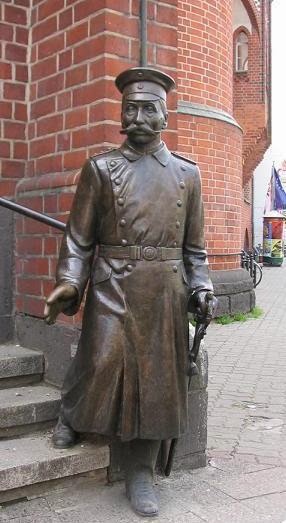
Even after the deception was eventually discovered and Voigt was caught, he was not harshly punished.  He was pardoned by the German Kaiser Wilhelm II himself because the Kaiser was said to have been pleased with the authority and reverence commanded by his military, and he found the whole situation rather amusing.  This reverence was due to the social power held by military captains; according to Rhetoric in Civic Life this is "the influence that people possess within a particular social structure, and that enables them to induce others to act" (163).  The high ranking military officials are respected and obeyed by all; by impersonating an officer, Voigt possessed the authority to convince others that what he was doing was not criminal.  Also, his crimes did not physically hurt anyone, and most people saw the whole incident as comical.  That is why a statue of Voigt now stands on the steps of the very same city hall that he robbed all those years ago.

By combining the right tools of rhetoric, Voigt was able to create a trusted identity, convince others of his authority and establish a credible ethos.  In doing all this, Voigt was able to steal an enormous sum of money and secure his place in history as the Captain of Köpenick.  It just goes to show that rhetoric can be and is most definitely used in every situation.

Cited Sources:

Palczewsky, Catherine Helen., Richard Ice, and John Fritch. Rhetoric in Civic Life. State College, PA: Strata Pub., 2012. Print.

"Hauptmann Köpenick" by Lienhard Schulz at de.wikipedia - Transferred from de.wikipedia - de:Bild:Hauptmann Köpenick.JPG.first upload: 22:12, May 11, 2003 - de:Wikipedia by the photographer. Licensed under Creative Commons Attribution-Share Alike 3.0 via Wikimedia Commons

Thursday, September 25, 2014

Ephemeral Permanence: The Horrifyingly Beautiful Constraint of Digital Media

I have often wondered what my last words will be. I know that, someday, I will die. I know that, even if I live to be over 100 years old, I will only have lived for a fraction of a percent of human history. Thus, I want to leave my mark on whatever history humanity has left to write. I would prefer that, when I die, I say something particularly eloquent and memorable (nothing at all like Civil War General John Sedgwick’s last words: “They couldn’t hit an elephant at this dist-”). I am perfectly aware that that a wish to leave a mark on the world, particularly through words, is shared by most if not all of the human race. We stand, staring into the face of the future, and wonder about how long our words will last. The answer is, of course, that they will not last long at all.
            One may think that, in the new world of digital media, written words and other forms of rhetoric will last forever. This is not necessarily true. It is true that our words on Twitter, our videos on YouTube, and our photos on Facebook are saved electronically, but this does not necessarily mean that they will be remembered. Even words written in stone do not go unforgotten. This turns the mind to a poem called Ozymandias, written by Horace Smith in the early 1800’s. It is as follows:


I met a traveler from an antique land
Who said: “Two vast and trunkless legs of stone
Stand in the desert. Near them, on the sand
Half sunk, a shattered visage lies, whose frown,
And wrinkled lip, and sneer of cold command,
Tell that its sculptor well those passions read
Which yet survive, stamped on these lifeless things.
The hand that mocked them and the heart that fed:
And on the pedestal these words appear:
‘My Name is Ozymandias, king of kings:
Look on my works, ye Mighty, and despair!’
Nothing beside remains. Round the decay
Of that colossal wreck, boundless and bare
That lone and level sands stretch far away.”

Clearly Ozymandias did not live forever, and his empire did not last. Even though his words were set in stone, they are nearly dust. There are no works to look upon and despair about. Even a man who was once feared and admired for his power and wealth cannot make his words last for eternity. Lives end, empires crumble, and words turn to dust. All one has to do is wait for a certain amount of time. Certainly, different media have different “life spans,” so to speak. This begs an answer to the question “How long does digital media last before it ‘dies’?” Certainly Facebook Posts, YouTube videos, and tweets are “saved,” but this does not guarantee their eternity in our memories. Such a nature offers a constraint which limits and provides opportunities for the rhetor’s persuasive choices. This is both a blessing and a curse. Digital media offers millions of people a chance to create content and communicate. That amount of interconnectivity between different people is impressive and, frankly, beautiful. However, this means that an extremely large volume of material is created. This hinders the amount of genuinely enjoyable content that will be viewed or remembered. Content is often buried under boundless amounts of other material. This makes tweets, for example, extremely ephemeral in nature. That is not to say that a tweet will eventually cease to exist. Tweets can be saved permanently, assuming the electronic means to do so are available. It is to say that tweets do not last very long before they are forgotten: before they “die.”
Out of curiosity about exactly how ephemeral their nature is, I found this article by Randall Munroe, a former NASA roboticist with an interest in hypothetical thought experiments. He calculates that a Twitter timeline that followed every user would stretch for eight million kilometers. That is approximately 345 billion tweets, and the number has grown since his calculations. Using an approach to statistical analysis known as the “German tank problem,” he approximated that Twitter will reach the end of its lifetime by 690 billion tweets. This would theoretically occur in about five years. Twitter’s short expected lifespan makes it very difficult to argue that such digital media will last very long. Even if content lasts long, it will be lost in a mass of tweets, videos, and photos. The media certainly shapes the message. In fact, digital media shapes billions of messages. It makes their lives in our memories incredibly short. Authors and creators of content on the web enter the process of constructing material knowing that whatever they make will not last long and may be lost in an unnavigable sea of digital matter.
One can easily see this constraint: that digital media itself not only makes it easy for written words to be forgotten, but forces written words to be forgotten. This makes leaving a meaningful legacy or mark on the world through digital media effectively impossible. There will always be new content being generated, burying the old. The sands will fill in over our digital monuments, and over time, they will be lost.

Source:

Palczewsky, Catherine Helen., Richard Ice, and John Fritch. Rhetoric in Civic Life. State College, PA: Strata Pub., 2012. Print.

Against Dissoi Logoi

When we look at a concept and think "this is something I believe," we do so for some reason. Inexhaustively, maybe some powerful authority, like a beloved parent or feared autocrat, has coerced us into believing the concept; maybe some eloquent rhetor has crafted a beautiful argument that we can't rebut; or maybe we have thought through the concept ourselves and reached our conclusion independently. We accept a concept when we think it is in our best interest to do so. We trust our parents' guidance or fear an autocrat's authority; the rhetor uses our thoughts and emotions to persuade us; or we conclude for ourselves that there is some benefit. Nobody believes that what they believe will hurt them.

The argument for dissoi logoi concludes when we see the benefits of looking at both sides of an argument. More precisely, it ended when our beloved professor said "dissoi logoi good" and nobody questioned him, but we'll just ignore that. Ostensibly, by recognizing both sides of a controversy as legitimate, we give ourselves a fair and accurate view of a situation. We accept this concept because we believe it will give us the most precise picture of reality that we can have. Dissoi logoi is good because when what we believe is true aligns with what is actually true we can make decisions with greater efficacy.

But let's look a little bit deeper. Dissoi logoi is predicated on a handful of things, like the existence of language and people being willing to talk to one another instead of pulling out guns. We needn't focus on things that aren't controversial, but we won't pretend that every smaller idea dissoi logoi contains is worthless. That said, we will find points of contention if we look.

The first thing we should notice is the prefix "di-" at the beginning of the term. Two. Dissoi logoi is not the idea that there are two sides to every controversy but the idea that there are only two sides to every controversy. This allows for the creation of nicely structured debates when having a hundred voices to listen to would result in nothing but cacophony, but it comes at a price. Ninety-eight of those voices must either be silenced, or their owners must associate themselves with the two speakers, shedding or perverting the beliefs they themselves had wished to express, exchanging their honestly reached conclusions for identification with one of two "legitimate" sides in the controversy.

The necessity of picking a side not only stifles individuals, but makes it more acceptable for us let others do all of the thinking. We won't be heard even if we speak; dissoi logoi only has room for two. Why make the effort to think for yourself when you have to jump on the nearest bandwagon anyway? Suddenly, a democracy that enshrines dissoi logoi isn't ruled by the people, but by the rhetorical elite. The best speakers become the democracy's oligarchs, backed by those who couldn't or didn't want to speak loudly or quickly enough to lead instead of follor. We suddenly have a society divided into "us" and "them," with each group led not by its constituents but by its rhetorical aristocracy.

This leads us to the next contention we ought to notice. Dissoi logoi is inherently competitive. Think of an instance where dissoi logoi could be found. Any formal debate tournament. Courtroom proceedings. Talking to your friends at lunch when one of them proudly declares himself an "anarcho-capitalist" (I never got a good explanation of what that is from him, but it apparently has a wikipedia page). You're practicing rhetoric with someone; you want to win that trophy, to improve your career prospects by winning another case, or to convince your friend to stop proselytizing for obscure political groups and let you enjoy your dollar-menu cheeseburger.

We're arguing with someone, and we want to win. After all, our position could never be wrong, could it? We aren't out to seek the truth, we are out for glory. If we only see two sides of a controversy, we develop an "us versus them" mentality. We stop caring about the best answer, and employ rhetoric not to find the truth, but to reaffirm the convictions we had before the debate began. Rather than thinking heuristically, trying to take what we know to be true and discern further truths, we think competitively, trying to take what our audience knows and twist it to make what we believe appear true to them.

I won't argue that dissoi logoi is worthless. It is certainly better to acknowledge only two sides of a controversy than it is to deafen yourself to every dissenting voice you hear. I only complain that we could do better than just two. We could hear more than just the two loudest voices in the room; we could be led by the best qualified instead of the best spoken; we could discuss with the intent to learn instead of the intent to win. We see more benefit when we move beyond the limitations of dissoi logoi.

For those of you feeling poetic: Reality is not just black or just white. Reality is not both black and white. Reality is a vast, vibrant spectrum of color; don't pervert the rainbow.

Wednesday, September 24, 2014

Could a Search Engine Improve Dismal Listening Skills?

With all this talk about “filter bubbles”, we have no reason to argue about that the internet is catered to us. If we click on posts about funny cat videos, then the internet will suggest more cat videos. If a person tends to support more liberal ideas, then Facebook will promote their liberal friends’ posts. Overall, we aren’t forced to encounter opinions that are not our own. By avoiding different ideas, we are becoming more radical and less open to new ideas. As a whole, society is becoming awful listeners. 

I found an article while wasting time the other day at lunch about this new search engine called “Yossarian”, the metaphorical search engine.

Read the article here

While still called a search engine, Yossarian is a lot different than our friend, Google. Here’s a visual representation on how Yossarian works.

Instead of getting a list of websites related to a search term, Yossarian reveals metaphors created by other users to get the readers to think about different perspectives. For example, if I were to Google “depression”,  links to sites about the symptoms and signs of depression come up. But when I searched depression on Yossarian, I got this image.
Some Yossarian user compared the word “depression” to a picture of an ejection seat. This got me thinking about what this specific user was trying to say about depression. How was the user using the symbol, in this case an image, to explain his or her view on depression.  My thoughts were that depression is feeling like there is no escape but to eject yourself from your usual life. I picture in my mind that those who battle depression hide in sadness away from everyone else. A few minutes later, I discovered I could see what the user was trying to evoke by hovering my cursor over the picture. I then was presented this image. 
@A_Parrintly formed the simile: "Depression is like crashing. Depression is the inabiltiy to fly, seeing only one way out -- ejection from the pilot seat." We did agree that depression is comparable to ejecting yourself from your life because you see no other options.  Personally, the word "crashing" wasn't in my initial self-discussion about the image. The user forced me to think about depression in a new way. It made me use my creative side to connect depression and a picture of an ejection seat. Yossarian is actually promoting creativity on the internet, by showing users all sorts of different comparisons for words users already have a pretty solid definition for. 

Here are some other examples I ran across that caught my attention. 


Now while these images are neat comparisons, you may be wondering how the relate to what this blog is truly about. If we are to look at the evidence being presented to us, the internet is resulting in more radical opinions and beliefs. Facebook is hiding opinions they think you won't agree with. Flipboard is tailoring news to things that fall in your belief system. Google is filtering results to match things you previously clicked on and is hiding results that hold potentially new ideas and new perspectives. This phenomenon has become known as the "filter bubble", an area of the internet where only your opinions are seen. These algorithms which filter results result in polarization more severe then society has seen in the past. With opinions becoming more radical, the art of dissoi logoi, the art of debating two sides, is becoming irrelevant. People just don't accept the other side of the argument anymore because of this radical polarization. People refuse to listen.

However, websites like Yossarian, can open this mind up to this concept of listening to the other side. While these comparisons may seem like a small thing, they can potentially begin to revert the effects of the "filter bubble." Yossarian is allowing users to see other's perspectives. It is allowing us to see how other people make connection between words we see everyday. If we come across a post on Yossarian which gets us thinking, we are opening our mind up to another perspective. We are listening to the other side. I believe if we continue to use websites like Yossarian, we as individuals can expand our spectrum of opinions, improve our listening skills, and potentially fight this plague of polarization. 

Feel free to check out Yossarian for yourself at www.yossarianlives.com

Sources:
"Can A Search Engine Make You More Creative?" Fast Company. N.p., 22 Sept. 2014. Web. 24 Sept. 2014.


Tuesday, September 23, 2014

The Filter Bubble

            The filter bubble is a comfortable and cozy area of the Internet where one can feel like they belong because the views and opinions in that filter bubble are all similar. The voices that fill that filter bubble are voices of agreement and support, not voices of constructive criticism, nor voices of disagreement. The problem with the filter bubble is that people are not being exposed to difficult situations and are not being challenged to critically analyze and consider different viewpoints and opinions on a variety of subjects. Websites like Facebook and Google collect data to create algorithms that determine what a person will see on their Newsfeed and Google Results. The filter bubble has created a space where dissoi logoi is no longer required in order to participate in a meaningful conversation in which participants are able to disagree with one another.
            On the other side of things, people have conversations and arguments all the time through public Facebook posts, YouTube comments, Tweets, and the like. People are always calling each other out on little things like grammar to the more important things such as ideals and beliefs. From what I’ve witnessed on Facebook, a lot of the time people are tearing each other down for what they believe or something insignificant they said. Comments are dissected down to a single word or a single phrase that was used. These dissections of comments may not be the most constructive way to participate in dissoi logoi, but it is still beneficial that people are able to partake in constructive conversations. Although these conversations happen within a personalized filter bubble, people are still communicating, using rhetoric, and arguing. The content of an argument within the filter bubble is limited because of the customized algorithm of the filter bubble; however humans are social creatures and will interact with others in anyway that they are able.
            Social interaction through the Internet creates a safe environment for people to voice their opinions and debate different topics. This safe environment becomes even safer through the filter bubble because the people that are debating often share similar, if not identical, opinions. The filter bubble decreases the amount of media that really matters and filters in the posts that will put people in a good mood rather than putting people in a situation where they might actually have to use their brain. Humans, although they are social creatures, are also creatures of comfort. People want to see the funny memes and the latest weight loss trends and the celebrities that are “just like us”. These things, while entertaining, are not things of importance to the world. These entertaining articles are there to distract people from the important things going on in the world such as the crisis with ISIS, troops being deployed, people starving and the like. These topics are often on the outside of most people’s filter bubble because they are difficult subjects to discuss because they make people uncomfortable. These uncensored posts about difficult subjects are rich in subject matter for people wishing to participate in serious discussions.

            The filter bubble creates a safe environment for friendly debate mostly about insignificant topics. Without the filter bubble the people of the Internet would be exposed to a wide variety of topics to discuss and analyze and form opinions on so that they can debate and discuss what is meaningful to them.

Monday, September 22, 2014

Twitter Switching to an Algorithm?

In class we have discussed how Facebook began using an algorithm to filter what a user sees and what a user doesn't see based on what they supposedly like.  While it keeps users from becoming overloaded and bored with their news feeds, it seriously inhibits users from obtaining information that may actually be quite relevant to the user despite what the algorithm thinks.  I often get status updates from friends that I am not particularly close to while some of my best friends are not included on my news feed.  Facebook maintains that this is the best way to keep users from getting bored with their news feeds and therefore bored with Facebook despite criticism the company has received.  Twitter has not begun using an algorithm like Facebook which is part of the reason why Twitter has gained so much popularity recently.  On Twitter, users see every post by all of the people they follow in reverse-chronological order.  Users, such as myself, really enjoy the fact that they can see everything posted and therefore there is no filter on the information available to them.  However, recently, Twitter has been considering switching to an algorithm just like the one Facebook uses.  The company's CFO hinted at it during a finance report meeting.  This has upset many of Twitter's loyal users.  The company says that there are benefits to using an algorithm such as keeping important news at the top of the news feed instead of getting buried at the bottom of the stack while the user is not on.  Personally, I think that Twitter should not change to an algorithm because then we lose much of what makes Twitter so popular.  The fact that I can see every tweet is what keeps me interested in Twitter while Facebook has become a big group forum for me and not much else.  If Twitter begins using an algorithm I will probably lose interest in in just like I lost interest in Facebook and I will begin looking for the next social media site that doesn't use an algorithm to limit my information.  We live in an information hungry world and that's why social media sites like Twitter and the old Facebook became popular.  When a social media site like Facebook limits, filters, and sorts this information for us, we not only lose the ability to decide for ourselves what is relevant and what is not, but we lose a lot of information in general.  I've posted the link to the website where I read the article where I got all of my additional information on Twitter's possible shift in information sorting below.  What do you all think?